
When we say that Johan Cruyff was the most influential footballer in Dutch history, few would disagree. The Amsterdam native left an indelible mark on the world’s most popular sport, bringing eternal pride and glory to his homeland. Yet, remarkably, his national team career ended without fanfare, overshadowed by fear for his family.
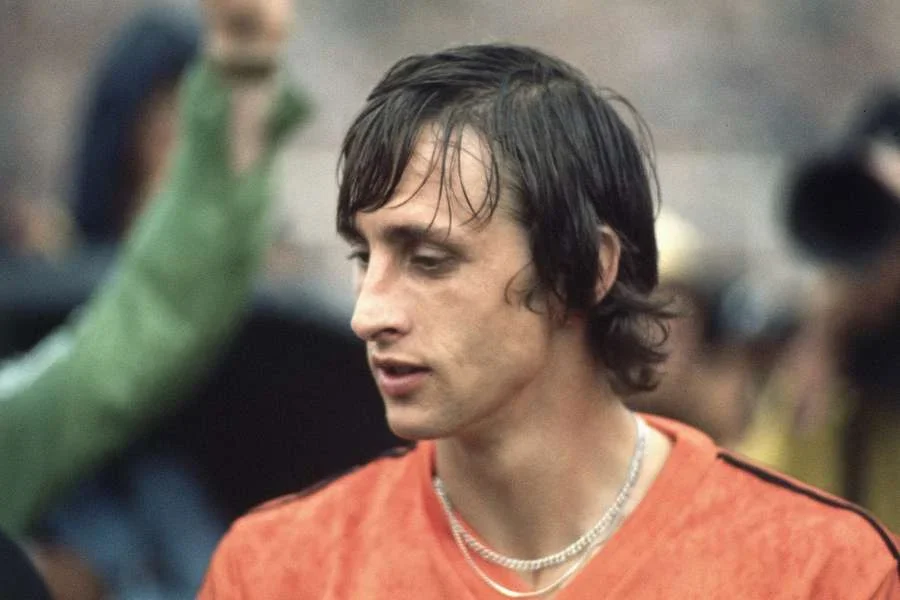
Johan Cruyff in 1974. (Credit: INTERFOTO / History, INTERFOTO / Alamy / Profimedia)
A Legend Among Legends
Cruyff wore the jerseys of several clubs during his playing days, but his best years were with Ajax and Barcelona. A three-time Ballon d’Or winner (1971, 1973, 1974), he collected countless trophies and became the symbol of the so-called Total Football pioneered by legendary coach Rinus Michels. While his club achievements are well known, his international career—far less brilliant—deserves a closer look.
The Underdog Emerges
The Oranje have long been considered favorites for the World Cup or European Championship. But it wasn’t always that way. Before Cruyff’s generation, the Netherlands were not among football’s superpowers, and their success in major tournaments was extremely limited. For instance, they failed to qualify for the World Cup in 1950, 1954, 1958, 1962, 1966, and 1970, and played only minor roles in European competitions. The game was dominated by Brazil, Italy, Germany, and England, while the Dutch were viewed as outsiders.
Total Football Revolution
The situation began to shift in the late 1960s and early 1970s, when a generation of immensely talented players emerged around Cruyff. Under coach Rinus Michels, the team adopted a modern, highly dynamic style called Total Football. The system relied on constant movement, positional interchange, and collective pressing. Cruyff was the chief organizer on the pitch, controlling the tempo, creating chances, and finishing moves. His influence also extended to the team’s mentality: as captain, he set a technical standard and an audacious, self-assured style against even the biggest powers. This helped shape Dutch football’s identity, emphasizing creativity and attractive play.
The golden age of this revolution came at the 1974 World Cup in West Germany. Led by Cruyff, the Netherlands reached the final, where they fell to the host nation. Still, the team became the darling of the world. Cruyff scored three goals and provided three assists, earning the tournament’s best player award. He played 48 matches for the Netherlands, scoring 33 goals, and his importance is underlined by the fact that the Oranje never lost a match in which he scored. They finished third at Euro 1976, but their star missed the final game due to a knee operation. That tournament went down in Czechoslovak football history, as Václav Ježek’s team first beat the Netherlands 3-1 in the semifinals and then humiliated West Germany in the final.
The End, Shadowed by Fear
Despite missing out on the title, the Dutch were optimistic. The team had transformed into a formidable force. However, for Cruyff, the story took a different turn. After a lengthy break from international duty, he was expected to lead the Netherlands at the 1978 World Cup in Argentina. But he withdrew at the last moment. Officially, he cited personal reasons, but it later emerged that fear played a central role: there had been an attempted kidnapping of his family, and the threat of further attacks made him decide to stay home. Some sources also mention a political aspect, as Argentina was under a military dictatorship at the time. Regardless, Cruyff’s absence was a massive blow to the Dutch, who again reached the final and lost to the host nation. His national team career thus ended quietly, a sad contrast to the glory he brought his country.