
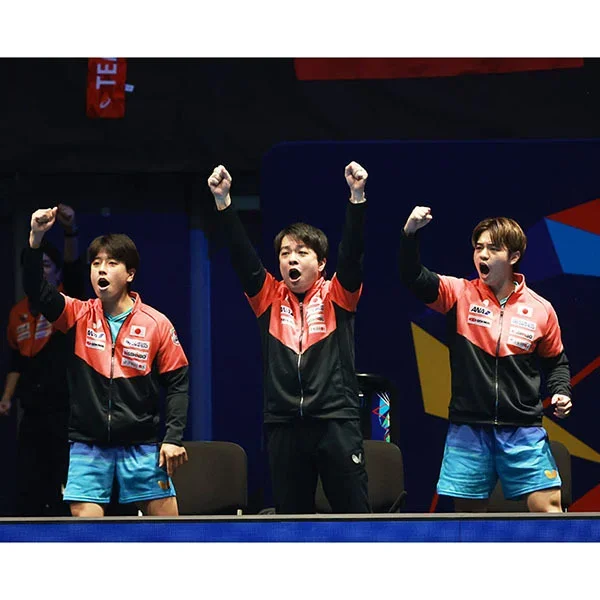
After Japan’s loss to China in the final of the World Table Tennis Championships in London, Seiya Kishikawa, in his first major tournament as head coach of the men’s team, finally saw his World Championships come to an end. Appearing in the mixed zone, he calmly reflected on the match.
“I’ve just finished the match, so the regret is stronger. Tomokazu Harimoto led 2-0 in games and was up 8-3 in the fifth, but couldn’t close it out. Not being able to pass that momentum to the second match is disappointing. If we had taken that point, we could have put pressure on the opponent. But overall, I’m very happy we won the silver medal. Regarding Harimoto’s comeback loss, Liang Jingkun has pulled off similar comebacks many times before—he’s incredible. Maybe Tomokazu was aware of that. It was more about mentality than tactics. Until the lineup came out, I didn’t know whether Harimoto would play third or be used for two matches, but Liang Jingkun was just too strong. Today’s China was a different team from the group stage. They truly are the world’s best.”
Looking back, in December 2024, the Japan Table Tennis Association’s strengthening headquarters asked Kishikawa to take over as men’s head coach, and the appointment was officially announced in January 2025. Kishikawa himself felt the timing was “early,” and there were genuine concerns among those close to the team—”Can someone who doesn’t talk much like Kishikawa handle it?” and “Will he be able to communicate with the players?”
However, since taking the reins, Kishikawa’s distance from his players has seemed ideal—neither too close nor too distant. He never wastes words, nor does he hurt the players’ feelings. More importantly, he is a man who truly understands table tennis. From his junior days, he experienced what it means to be a professional in the German Bundesliga, constantly honing his skills against world-class opponents.
Even as a player, Kishikawa was never one to speak unnecessarily. Even when those around him wished he would assert himself more, he stubbornly chose to express himself through his play. On the surface, he appears to be a “natural talent,” but behind that image lie years of studying abroad in Germany from middle school, as well as the glory and setbacks of representing Japan. He even had a bitter experience of being excluded from the national team and, in protest, refusing to attend training camps.
Knowing the emotional nuances of being a national team player, Kishikawa must have felt bad for Shinozuka and Uda, who had no playing time and saw the team essentially fight through just three players. But he surely talked to both of them, explaining the team’s situation and his reasoning.
Uda said, “I prepared as an individual. Even without playing, once I was selected, I aimed for the gold medal as part of Team Japan. Winning silver was good, but because everyone honestly wanted gold, it stings. Still, this tournament is a stepping stone to the future.” Shinozuka added, “Since Kishikawa-san chose me, and I didn’t get a chance to play, I focused on cheering with all my might. Watching from the bench, I saw how amazing the matches were, and it made me truly want to fight on that court too.” These experiences will surely be valuable to both players.
The London World Championships marked Kishikawa’s first medal as a national team coach. When asked if it felt different from his playing days, he replied:
“Completely different. As a player, I only ever won bronze medals at the World Championships. Of course, the challenges of coaching are different. Reaching the final was good, but I—and my players—genuinely wanted the gold medal. That emotion is different from my playing days.”
Whether after winning the semifinals or losing the final, Kishikawa’s emotions never swung wildly. But compared to his quiet playing days, his post-match comments are now longer and more precise.
In two years, the World Championships will be held in his hometown, Fukuoka, and that summer, the Los Angeles Olympics await.