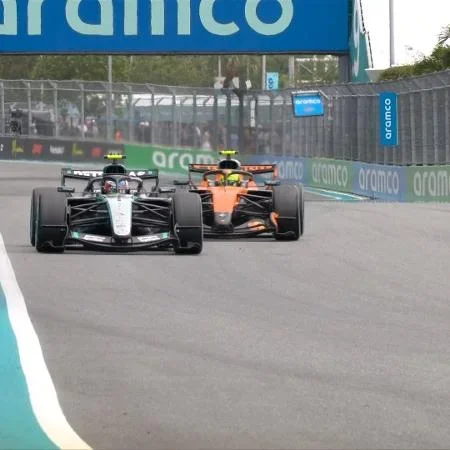
Formula 1 introduced a package of changes last weekend in Miami aimed at better balancing the role of electric energy in on-track battles. The race pleased fans much more, with Toto Wolff even saying that anyone who didn’t enjoy it “should hide themselves.” However, the drivers felt little difference and recognize that the “truce” came more from the track’s characteristics than from the new rules.
{“IMAGE_0”}
“It’s a small step in the right direction, but it’s still not at the level Formula 1 should be at. In qualifying, if you push flat out all the time and try to drive like in previous years, you are still penalised for that,” said McLaren’s Lando Norris. “You can’t go full throttle all the time. It’s not about accelerating too early continuously. You should never be penalised for that kind of thing, and it still happens. Honestly, I don’t think this can be solved. It only serves to shorten battery life. I hope in a few years it changes.”
Max Verstappen, the most vocal critic of the 2026 regulations – which introduced an engine with about half its power coming from the electric part, constantly needing recharging due to a smaller, lighter battery – said the car is now “less stressful to drive,” but that has more to do with Red Bull’s improvement than the actual changes. “My car is a bit better, but what I said before about the regulations remains the same. I didn’t feel I was driving differently. You still have to go slower in some sections to go faster, so it’s still not how I’d like. That’s not how it should be. At least my car is working a bit better, so it’s a little less stressful to drive.”
Oscar Piastri warned that one of the problems the Miami changes aimed to fix still exists: big speed differences between drivers using different energy strategies – for example, when one is recovering energy and another is releasing full power with the overtake mode. “I think reducing the recovery limit in qualifying helped a little. The races are basically exactly the same. And it’s crazy, to be honest. At one point, I saw George [Russell] was 1 second behind me and managed to overtake me at the end of the straight. It’s kind of random. The closing speeds are huge, and trying to anticipate that as a defending driver is incredibly difficult. I wasn’t very happy with one of George’s moves, but then I pulled almost the same move five laps later precisely because the closing speed is enormous. I think the collaboration between the FIA and F1 has been good, but there’s a limit to what we can change with the hardware we have.”
As Piastri pointed out, there is a limit to what can be done going forward. The Miami changes focused on engine software, something that can be easily altered. Deeper changes are possible, but they would negatively affect car speed. Meanwhile, F1 is studying increasing fuel flow (which some believe is only possible for 2028) and reducing aerodynamic downforce (for 2027).
However, not everyone agrees that the regulations need radical change. Charles Leclerc has enjoyed the new battles based on energy management from the start. “I know I’m a bit different from others on the grid, but I feel that, at least in the fights I’ve had with the other drivers, it’s been exciting.”